


When Watches Become Memory

Dernière mise à jour : 18 sept.
Roy Davidoff, Founder of Roy & Sasha Davidoff SA
Some passions begin with an object.
For Roy Davidoff, it began at thirteen, when his father gave him an Omega Speedmaster from 1969. The excitement was immediate, and so was the first lesson. Within minutes of receiving the watch, Roy accidentally dropped it, shattering its crystal. Years later, that same watch would become one of the pieces he would never consider selling.
It is a fitting beginning to a life devoted to watches, because for Roy, collecting has never been simply about the objects themselves.
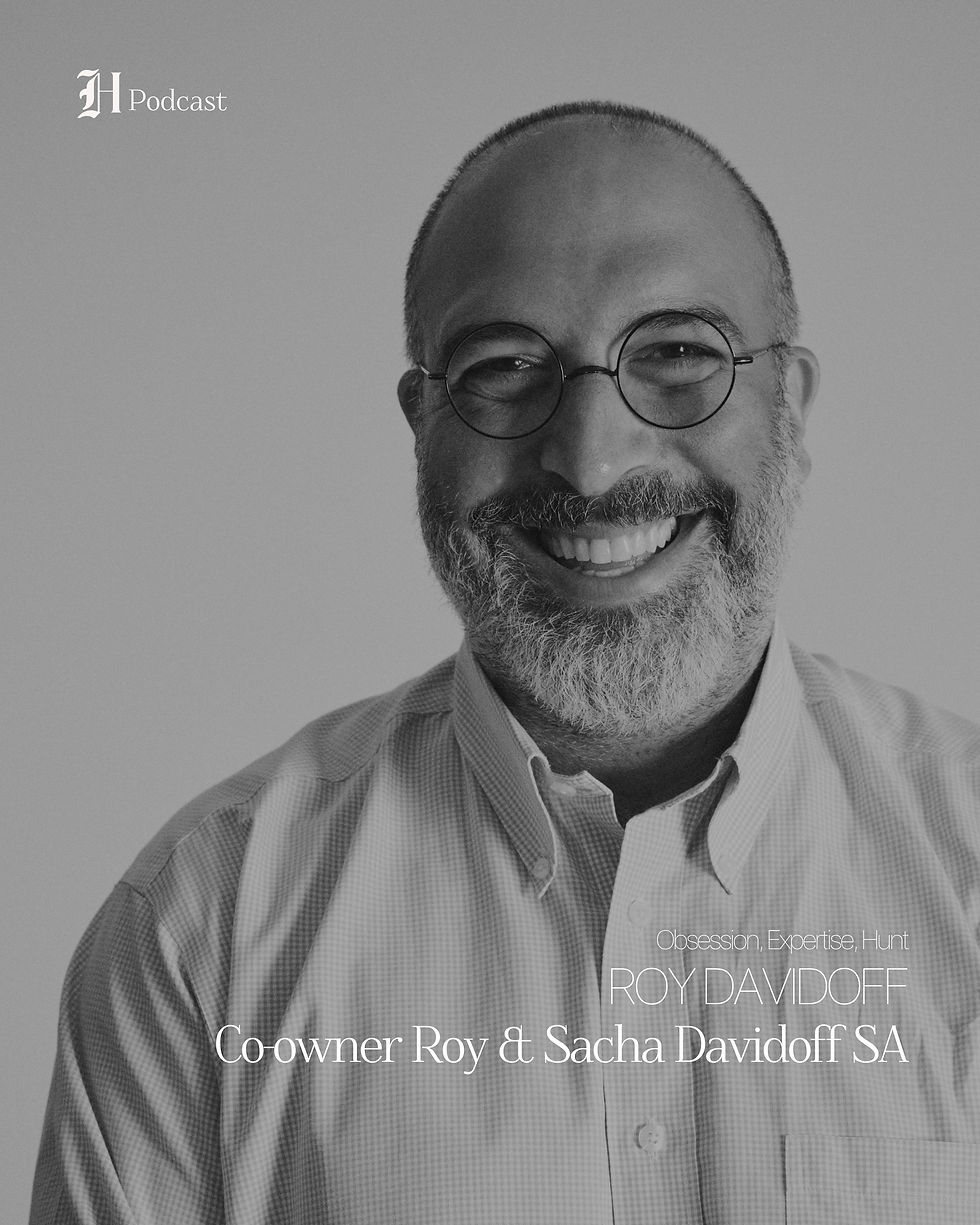
Growing up in a family deeply connected to jewellery and precious stones, he learned early to look beyond appearance: to understand craftsmanship, materials, provenance and the hands that created an object. Over the decades, this curiosity became a profession. Together with his brother Sasha, he founded Roy & Sasha Davidoff in 2014, building a reputation through an obsessive attention to detail and an extraordinary knowledge of vintage watches.
But what makes a watch truly special?
For Roy, rarity alone is not enough. A watch needs to trigger something.
“I want to buy a watch because it fits, because it has a feel. It has a look. It triggers something from my past.”
This idea runs throughout his approach to collecting. A watch can recall a moment, a person, a period of life. His own collection is filled with these connections: his first Speedmaster, his grandfather’s watch, the watch his father wore at his parents’ wedding, and a Speedmaster given to him by his brother. The object becomes a repository for memory.

His fascination with vintage watches also comes from another kind of memory: the memory contained within the object itself. Years spent examining dials, movements, case makers, serial numbers and archival documents have taught Roy to read watches almost as historical documents. A change in lume, a printing technique or a case-maker’s mark can reveal when and how a watch was produced, sometimes challenging the simplified narratives found in books or online.
This is where collecting becomes something closer to research. And perhaps this is also why Roy remains fascinated by the hunt. Over the years, he and Sasha have travelled across countries to find rare pieces, tracing watches through families, dealers, archives and chance encounters. The pursuit is not simply commercial. It is investigative: an attempt to reconstruct the life of an object.
Yet behind the watches lies another story: that of two brothers building a business together.
Their relationship has evolved from childhood and family into partnership. Roy describes Sasha as someone he trusts completely, while acknowledging the inevitable friction that comes with working so closely together. Their differences have become part of their strength: complementary personalities, shared knowledge and, above all, a deep mutual trust.
That trust is particularly important in a world where provenance and reputation can matter as much as the object itself.
Roy is candid about the difficult side of the business too. There have been mistakes, scams, financial losses and periods of uncertainty. Success, he admits, has come at a cost, particularly in terms of time and health. His approach to failure has therefore become increasingly pragmatic: acknowledge the mistake, learn from it, and move on.
He compares it to tennis: "You have only a few seconds after a mistake before the next point begins."
Perhaps that philosophy also explains his perspective on the future of independent watchmaking. Roy remains deeply interested in emerging brands and young watchmakers, but insists that originality alone is not enough. For him, successful independent watchmaking requires understanding the buyer, building trust and developing a coherent identity rather than simply following what the market expects.
Ultimately, Roy’s definition of success remains surprisingly simple: being able to acquire the watches that truly matter to him, continue building his collection, and share knowledge and experiences with others. Because when he imagines how he would like to be remembered, he does not speak primarily about business. He hopes people remember the watches, the knowledge he shared, and the experiences they had along the way.
A watch tells the time. But sometimes, it also tells us who we were, where we came from, and what we choose to carry with us. And perhaps that is what makes certain watches, and certain stories, truly timeless.


Commentaires